

Before we dive in, I owe you an apology. I’ve not been as responsive as I aim to be in Direct Messages, and I’m aiming to get back to you soon. Thank you!
Hi fellow writer,
I hope you’re having a peaceful first advent.
I’m writing today’s edition from a coffee shop with a view of the local Spånga center and pensioners headed to buy saffron cinnamon buns (coziness 6/10).
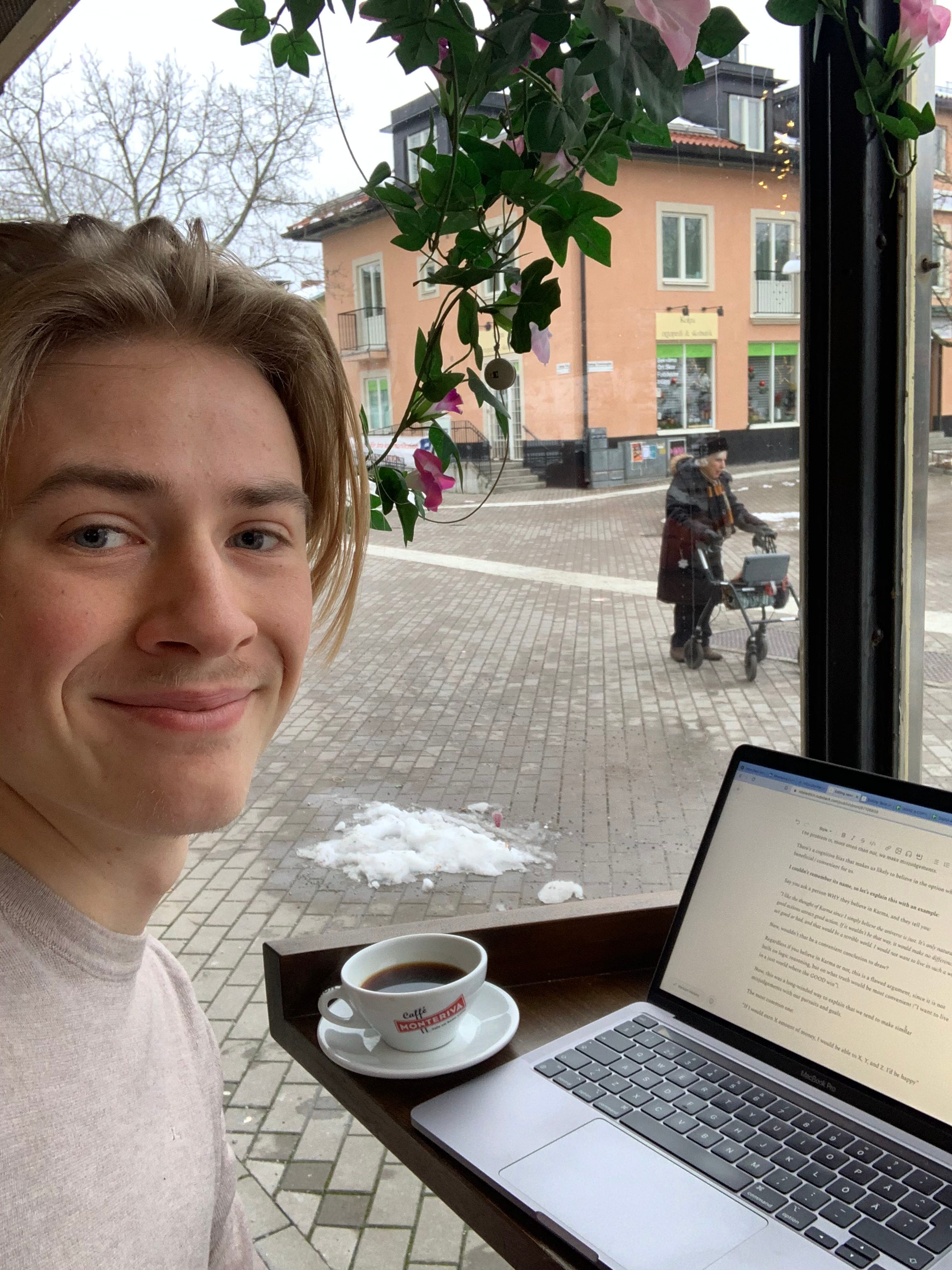
Everything’s coloured concrete grey or snow white - I couldn’t come up with a better place for listening to Deep Techno.
Originally, I desired to make this letter about creating ultra-helpful content in abundance.
But, I felt more like writing about philosophy today.
So, expect some food for thought this week, and a golden resource for writing systems next week.
This week’s topic might be a bit controversial, so I want to add a disclaimer:
What I’m about to cover isn’t aimed to be true for everyone living on earth, but rather targeted at highly ambitious individuals in the startup environment that have financial safety (don’t live month-to-month).
We’re in constant pursuit of something.
I’m fascinated by the fact that we humans are in constant pursue of something.
There’s always something we WANT.
No matter how big and meaningful achievements we make, we are always up for a new desire.
Even the craziest goals, which we work decennia to achieve, only satisfy us temporarily.
Without a pursuit or desire, we feel purposeless.
I accredit much of our success as a species to this attribute.
But it endangers our happiness and judgement in the modern age.
Taking on new desires and pursuits make us treat life like a finite game, despite it being an infinite one (Simon Sinek explaining the difference).
Thing is, the game of life is never beaten - we keep on taking on new desires, pursuits, and set new goals. Even the BIGGEST goals will only put you a bit ahead. You’re never “done”.
That’s why it is dangerous to make one goal THE GOAL for your existence.
We tend to overemphasise how impactful reaching one goal will be for our life
“When I have X, Y will be solved”
The problem is, more often than not, we make misjudgements.
There’s a cognitive bias that makes us likely to believe in the option which is more beneficial / convenient for us.
I couldn’t remember its name, so let’s explain this with an example:
Say you ask a person WHY they believe in Karma, and they tell you:
”I like the thought of Karma since I simply believe the universe is just. It’s only natural that good actions attract good action. If it wouldn’t be that way, it would make no difference if I act good or bad, and that would be a terrible world. I would not want to live in such a world”
Now, wouldn’t that be a convenient conclusion to draw?
Regardless if you believe in Karma or not:
This is a flawed argument, because it’s not built on logic reasoning, but on what truth would be most convenient (“I want to live in a just world where the GOOD win”).
Now, this was a long-winded way to explain that we tend to make similar misjudgements with our pursuits and goals.
We make ourselves believe that achieving our one goal will solve EVERYTHING, because we would like it to be that way.
This leads us to creating beliefs/assumptions that will make most of us unhappy.
“I just need to earn more money”
The most common one, that I’m myself guilty of:
“If I would earn X amount of money, I would be able to do A, B, and C, and I’d be fulfilled happy”
This is a terrible belief to have, because it by definition constrains you - by making A, B, and C products of X, you stop looking for other ways to reach them.
This makes it a self-fulfilling prophecy.
You begin by chasing money, and once you reach your goal of, say, $20.000 / month (if ever), you shift focus to getting into shape, spend time with your loved ones, and eating healthy.
A selected few might reach their income threshold and make the leap.
However, earning money often becomes a vicious cycle of dissatisfaction and greed.
We often forget:
Money is a store of value, thus can never be more than a means to an end.
When we reach our original target income after 3 years of hard work, we tell ourselves:
“This is not enough yet, I can actually earn twice as much if I keep working at this”
But unless we are in the clear of what we REALLY want, we’ll never be content with the money we earn, since we think our internal problem of lacking purpose will be solved by earning more money, an external solution.
It won’t work.
You don’t need more money
What if you, from the beginning, wouldn’t made money (a means to an end) the solution, and focused your efforts on the desired outcomes right away?
I think you’d be happier and reach your ideal lifestyle faster.
What do you REALLY need?
$400 extra in your bank account every month, or 5 more hours to spend with your family, on your body, or meditating every week?
I would take the 5 extra hours.
By focusing on our innate wants and needs first and money second, we are free:er in our choices.
How often do you really need more money, in either way?
Most quality of life issues can be solved by spending more time instead of money.
But we tend to try to solve them with money instead.
Some examples:
We buy Athletic Greens and supplements for $300 a month instead of taking time to put together and cook our own lunches using whole foods.
We go on expensive 2-week vacations to spend time with our beloved ones once a year instead of taking a pay cut, work less every week, and spend more quality time with family at home.
We work over-hours at our companies to gain prestige instead of sacrificing some social status for more time for other activities.
These are trade-offs, and it’s up for every one of us to decide how we want to live our life.
But remember:
You have a choice.
And I believe (& sincerely hope!) that this is no news to you.
The reason I’m still sending this letter your way is because we often forget this and go into tunnel vision when we’ve set a big goal.
I want to remind you:
Why are you doing this, and will pursuing this thing really bring you the outcome you want? Is there another way to reach your desired outcome?
This might make you unhappy at first, but…
When you go to the root of your existence and question WHY you do what you do, you might end up feeling purposeless.
You might feel as if you are guilty of overemphasising the impact reaching one goal will make your you.
You might feel as if you are enchained by your own beliefs.
You might feel as if you’re back to square zero.
You might feel stupid.
I’ve been there.
But after a minimal identity crisis, you are back on track, and you realise that this insight is GREAT for you.
You don’t need more money to get what you want.
This will make you feel free, since you’ll be able to re-focus your efforts to what really matters.
You’ll tell your boss you rather want to reduce your hours by 5% a week than getting a 5% raise.
You’ll stop chasing “shiny objects” for money.
When you realise that most of what you want is within reach for you today, you stop agonising about how you can earn more money tomorrow, and start looking for opportunities to be happy today.
One question to ask yourself after this edition
How would you live your life if…
…you’d have $1,000,000?
…you’d have $10,000,000?
…you’d have $100,000,000?
…money was not an issue?
Write down your answers - they will give you an idea of what your “ideal life” looks like.
Then, use this as a navigator for your decisions. I want X life, will this decision move me closer or further away from it?
Keep this heuristic and you’ll stay on track for your best life - but reflect on the earlier mentioned questions often, since the answers might change.
Life’s an infinite game.
Winding down
Ouf, this might’ve been a long and heavy letter.
I’m shouting out my own thoughts to your mind.
If this resonated with you, please let me know in the comments, or by replying to this email.
Wishing you a great week,
Nils
This line of thinking is ultimately determinate upon having enough resources to survive on. My family lives in the United States. Having more time is fantastic, and a great goal to have, but if you have time and NO resources, you find yourself starving and homeless.
This may not be a “welcome” thing to say, but it is true